 | | | | | | | | | | | | | | |
 |  |  |  |  | | |||||||||
 |  |  |  |  |  | | ||||||||
 |  |  | | |||||||||||
 |  |  |  |  |  | | ||||||||
 |  |  | | |||||||||||
 |  | | ||||||||||||
A Naturalist's Guide to Canyon Country
160 pp., 6x9", maps, color illustrations $22.95 ISBN 1-56044-783-4

A comprehensive guide to the geology, shrubs, trees, flowers, mammals, birds, fish, reptiles, amphibians, insects, and arachnids of the northern Colorado Plateau (encompasses eastern Utah, far western Colorado, and sections of northern Arizona and New Mexico). First-time visitors and seasoned desert rats will appreciate this well-organized guide with over 250 species identified. Includes over 200 black and white and color drawings by Gloria Brown.
"When I am hiking in the desert I will take
four items with me: food, water, a map, and this field guide. David Williams'
book is that essential and that critical to a desert lover's experience."
Terry Tempest Williams
Author of Refuge and Coyote's Canyon
Canyon treefrog Hyla
arenicolor
1 1/4 to 2 inches, prominent toe pads, skin color matches surroundings
with scattered small, darker splotches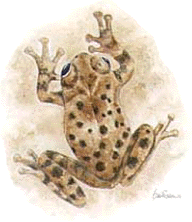
Canyon treefrogs depend upon camouflage to protect themselves from predators.
They blend in so well that you can overlook them even when staring directly
at them. These small batrachians rarely venture far from water during
the day and usually sit motionless in cracks, under boulders or behind
vegetation. They are active at night, sometimes traveling up to 200 feet
from water. Breeding occurs from March to July and eggs are laid singly
in quiet water. The tadpoles, which can grow to two inches, metamorphose
in six to ten weeks.
Similar to most desert toads and frogs, canyon treefrogs can tolerate high temperatures and severe desiccation. A warmer body offers several benefits including increased rates of food digestion, protection against bacterial infection, and control of external parasites. Dehydration also helps control parasites. Blood sucking mites, which live on treefrogs, will leave the surface of a desiccated frog. Drawing by Gloria Brown
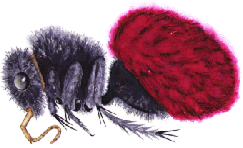
Velvet ant Dasymutilla
spp.
1/2 to 1 inch long, females wingless, densely covered with orange, red,
or yellow hairs
Most of us have been warned to not judge a book by its cover. One should
not judge insects that way either. Velvet ants look like hairy, extravegently-colored
ants, which might be fun to pick up. Do not be fooled. They are actually
wasps that have a particularly painful sting; one common name is "cow-killer."
The orange, yellow, or red wingless females, which are encountered more
often than the winged-males, are often seen scurrying across the ground.
She is probably searching for other ground nesting wasps or bees, where
she can deposit her eggs. When they hatch, the larva will consume their
host before pupating into an adult. The females emit a peculiar squeaking
when their body is pinched lightly. Needless to say, don't try this with
your bare hands. Drawing by Gloria
Brown
All material©David B. Williams 2000,2001,
2002.
All rights reserved, no form of reproduction is
authorized without prior arrangement with David B. Williams.
