|
Idealism focuses on the perception of the mind. The mind (what the brain does) is that part of the
body from which we can create our concepts of reality in any way we want. However, it is only with
the most realistic concepts that predictive and reliably applicable results can emerge.
Believe it or not,
everyone has a personal philosophy. To some extent, everyone explores all the
things philosophy explores. A life with a positive, uplifting philosophy will bring
forth a life worth living. Realistic Idealism is a philosophy about
humanity. It attempts to realistically resonate with our obligatory social
and individual characteristics, and simultaneously, extrapolate ideals of love
and compassion from the Judeo-Christian heritage. Finally, within our limited
bubble of awareness, we can know where we come from, where we are, where we are
going, and what things are possible.
Realistic idealism is not anti-theistic. It recognizes the value, and place, of reverence and
faith. It underlines the importance of love and compassion, and urges us to prepare for knowledge,
and understanding. This philosophy is not liberal (oppositional to traditional values), and also,
has no doctrine (a preconceived structure). It is founded in nature. This philosophy proposes that
one life, committed to the service of others, is enough.
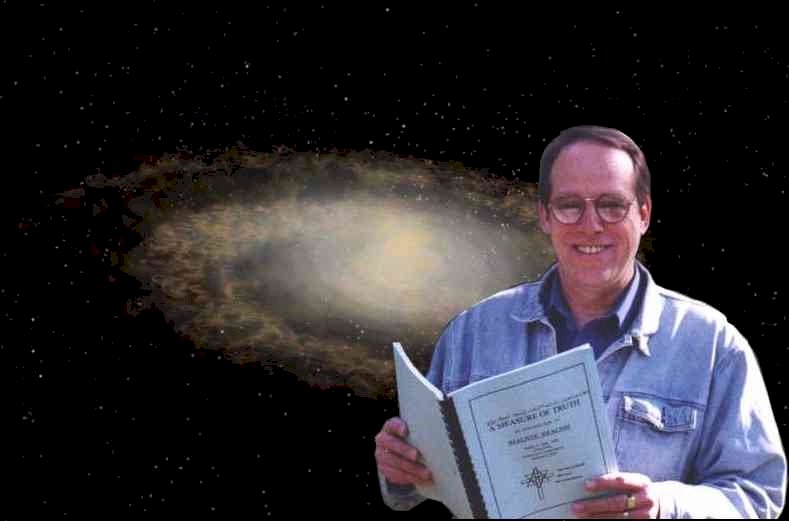
Although the idea of contributing to the body of philosophical thought had been on
Dr. Hall's mind from the time he was a young man, many of the concepts presented here originated from
discussions among his friends and were later delineated from 1975 through 1994 when he passed away. During this
time I worked with Dr. Hall as an editor organizing his thoughts. By the end of that time much work
had been completed, and I built this website. I tested the work by posting portions of the book on
Usenet, where challenging debate and criticism arose quickly. This has been a great learning period
for me in that I was motivated to go to the sources myself to defend or reconsider parts of the book.
A few parts have been deleted while other parts have been expanded. Everyone who comes to understand
realistic idealism is invited to build on its foundation as I have.
Scientific knowledge is the most successful way to understand our universe
Click The Book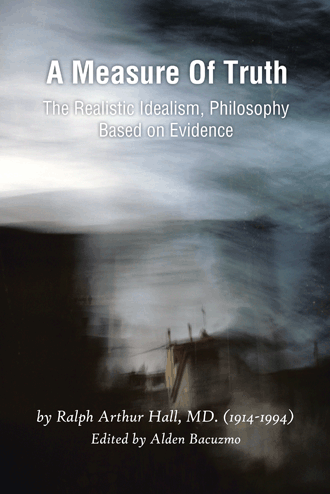
Introduction to
the Author and originator of the Realistic Idealist: Ralph A. Hall, M.D.
The Evolution Of Western Thought
Chapter 1.
The Opinion The disarming of knowledge and the abdication of leadership. The danger of
democracy is the uninformed people. What is an opinion?
Chapter 2. Understanding Knowledge
New knowledge will appear meaningless until it fits into the pattern of the knowledge already
possessed." Some of the characteristics of knowledge are discussed and why it is feared.
Chapter 3. G*D, Nature,and Reality This is
a brief history of the evolution of the concept of God from the evolutionary dawn of literacy to today. It shows
a progression and dimension up to and including the discovery of the scientific method: today's
ultimate discovery of G*D. What guidelines can be devised to limit erroneous thinking about God?
Chapter 4. Logic: Dialectic Whatever
Logic, alone, leads to futility. The futility of logic, without scientific knowledge, still rules most of
our social order.
Chapter 5. The Dilemma of Logic and Ethics.
Examples of the futility of logic as applied to ethics,and how morality can and should
be based on evidence. Morality based on evidence and consequence is the most convincing morality.
Chapter 6. The Language of Nature is
Science. Some of the mystery and all of the magic are stripped away from life as our ancestors knew it.
This is humanity's search for reality and the continued revelation of G*D.
Chapter 7. Reverence and Faith: The Road To
Equanimity This is basic human psychology. You will be introduced to the
"trinity" of Reverence: Identification,Dedication and Humility. You will find out
what these mean to the Obligated Social Being: YOU!
Chapter 8. Alienation: The Road to Despair
A fast growing, modern, individual affliction: the affect of ignoring reverence. The proof of the
existence of reverence.
Chapter 9. What is Truth? In this
insightful survey: "Truth" and "Fact" are no longer confused. In a way, Facts are
the strands of life, while Truth is the fabric of life. The Truths of life are revealed as Love, Beauty,
Work, Mystery, and Freedom. These become some of the basic principles of The Measure of Truth.
Chapter 10. Doctrines We are
alerted to the road blocks to understanding presented by doctrines, especially that of Boaz.
Chapter 11. Creation The Bible
describes creation in seven days. Why not one? Because, even back then, they knew that it was a process.
The Biblical creation was the most up-to-date scientific explanation of the time (it was Aristotle's
time, circa 600BC). It would have been published in the "Scientific Babylonian". This chapter
discusses scientific revelations of the further expansion of G*D's process.
Chapter 12. Ontogeny Every living
thing starts with one cell. Next to paleo-phylogeny, the development of life through the study of fossils,
ontogeny is the strongest indication of the existence of the evolutionary process.
Chapter 13. Evolution A discourse
about an understandable explanation of a truly beautiful, and, ultimately, obvious process of the development
of all life from one miraculous,or perhaps, predestined, cell. It has been said that "a chicken is an
egg's way of making another egg".
Chapter 14. Heritable Behavior and Abilities
Anything that is not heritable is of no evolutionary significance. The guides to heritability are, 1. social
or environmental pressures which encourage specific heritable characteristics in sexual mate selection, 2.
extermination of part or all of a population, 3. geographic separation allowing separate development, and
4. mistakes in DNA replication increasing the variation of a population.
Chapter 15. Learning and Motivation
Here is discussed some important aspects of the process of learning. Learning and the resulting change in
behavior is a neurological process with an evolutionary agenda. How can we shape our interaction with our
environment without an understanding of this process? For instance, Patricia Kuhl at the University of Washington
has excellent evidence that indicates language is learned through inherent physiology shaped to the prevailing
environment during a specific maturational window of time.
Chapter 16. Extinct Humans This is a short
description and discussion of our early, now extinct, human like variations from Ramapithicus to Cro-Magnon.
We take a side trip with Neanderthal.
Chapter 17. The "Fit and Capable"
The characteristics of the mind are determined by the brain. The racist condemns
all members of a stereotype to have no variation beyond what the prejudiced impression provides (no variation).
A wide range of genetic variation in regard to the brain and it's capabilities is essential for evolution to take
place. If some declare (in order to combat racism) that evolution and variation stopped 50,000 years ago,
their motivation is admirable, but the evidence is missing. In this chapter we explore the observed width
of variation through time among humanity's many families. It has to be emphasized that each human family is
widely variant and is continuing to evolve with the seeds of individuals from other families.
Chapter 18. The Search for Order This is the
introduction to our interpretation of the Old and New Testaments.
Chapter 19. The Old Testament: Judaism
Here, the real beginning of the Old Testament (Exodus) is interpreted from a new perspective. Scientific
verification is revealed. In hopes of unraveling some of the mystery surrounding one of the basic tenets of
western society, the Ten Commandments are explained in a way that give them new and deeper meaning... then and now.
Chapter 20. The New Testament: Christianity
Although virtually everyone thinks of Jesus as the Christ, there are some differences between what Jesus
thought and what Christians expect. To those who want the whole Bible/Jesus scripture to be a fabricated
novel, you still have to ask what the effect of this novel had, what was the philosophy projected by this novel,
and try to sort out it's realistic and mythological aspects. In spite of debatable variations and origins
of scripture, we can rest assured that Jesus highlighted the concepts of love, compassion, and forgiveness.
This is the basic moral tenet of The Realistic Idealist which now builds on this tradition.
Chapter 21. "Family Tradition"
Examining raising children, the effects of family on physiology, and some of the roads to sexual
identification.
Chapter 22. Crime and Punishment Examining
criminal behavior and our justice system from the perspective of evolutionary principles.
Chapter 23. A "Government in Truth"
A realistic approach to governing.
Chapter 24. The Practice of the Realistic
Idealist We have Love and Compassion. Now we have Knowledge and Creativity for those who are ready.
Chapter 25. "Closing Thoughts"
I wish you peace, health and happiness. It is not my intent to confuse, alter, or confront those
things that you hold dear, but to show you a path that I have found to a better life and peace of mind.
Links to essays by Alden Bacuzmo are as follows:
Psalm 104 This essay is a detailed study of
the relationship of Pharaoh Akenhaten's Hymn to his single God, "Aten" and psalm 104 in the Bible.
Religious Biblical scholars react to this challenge to revelation, while other scholars find this as verification to
the connection between Egyptian culture and the early Judaism.
The Quitter Everyone Loves Want To Stop Smoking?
A comedic, though informative, look at the act of the cessation of the intake of nicotine. This has information
you won't find anywhere else.
The Art Of Solipsism A new, fresh look at a
concept that has been long ago rejected and forgotten.
Atheism and Religion A conservative consideration
of inherent qualities that might account for the "religious experience".
The Deconstruction of Skepticism An over
simplification of subject matter that is kept sacred among the philosophical community.
The refuter's handbook A somewhat humorous
assessment of common internet etiquette.
The Great Mortgage Bubble An explanation of
our economic problem and an exploration of it's solution.
|