 |
|
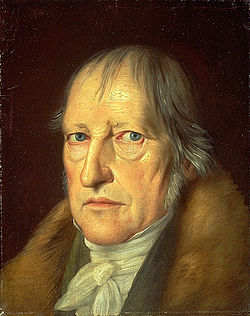 | Hegel (1770-1831 A.D.) glorified the dialectic principle by defining thesis, antithesis, and synthesis. His disputes began by stating the thesis of his antagonist, and then stating a contradiction in the antithesis, usually using similar words in an opposite sense. He then synthesized his own idea of the subject. |
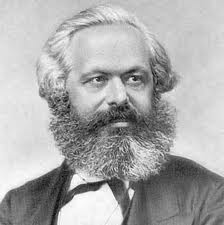 | Marx (1818-1863 A.D.) in his own words discussed the process of change through conflict of opposing forces whereby any given contradiction is characterized by a primary and secondary aspect, the secondary succumbing to the primary, which is transformed into an aspect of a new contradiction all of which is metaphysical. I'm afraid Marx said all that with a knitted brow. If he had had any sense of humor, he would have burst out laughing. How anyone can substantiate such an untidy bit of definition is hard to understand, but make no mistake, such a fraud has moved the Earth! |
|
If a person has had experience, however, and can relate his thoughts to reality, dialectics literally
makes no sense. The communistic philosophy of Karl Marx had one great flaw. He believed that all human behavior
could be changed by enculturation. He did not consider that Nature dictates laws that define human behavior,
and he probably would have ignored them if they had come to his attention, just as would many modern Scientists.
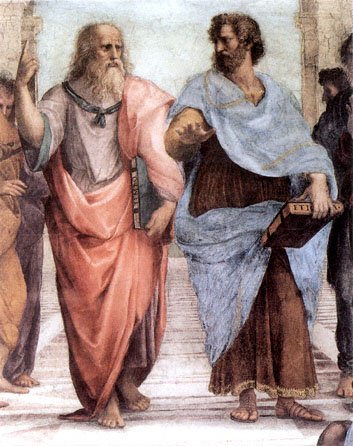
However complex the successive uses of dialectics by Socrates, Plato, Aristotle, Hegel, and Marx may seem, they are merely more complex definitions of the same thought process of contradiction. It really isn't that difficult to understand. No matter with what thought a person may begin, the dialectic disputant can immediately contradict him. The more clever and obscure the logic the better. Obscurity confuses and weakens a protagonist. Dialectics is a unilinear disputatious logic derived from an assumption which may have no part of reality, and where it does occasionally touch on factuality, it exhibits no comprehension. Ironically, such logic, when immature, can lead to some reasonable derivations, but never for long before the logic reaches levels quite distant from the factual plane. This characteristic is far from being limited to the ancient philosophers for it is prevalent in society at large today.
The blase futility of logic
The exception to the rule and dialectics
Since the beginning of academic testing there have always been exceptional students, average students, below average students and some students who are illiterate and are unable to be tested. As a rule, the offspring of exceptional students are also exceptional, and so it goes down the line. Illiterate people are having more babies and the illiterate population is growing. Students who are illiterate find it more difficult to obtain employment or start their own business, as a rule. However, exceptional people have come from average parents just as people of normal height have come from parents who are midgets. As well, there are people who are not exceptional who accomplish exceptional things. Babies are innocent and we love all of them. So, if we find that crime and violence are correlated with illiteracy, it could be said, it is the fault of the schools for not teaching them to read. If these individuals had jobs, they would not have the time to participate in crime and violence. Then it could be said, crime and violence is a product of too much unemployment and the inability of our teachers to educate their students to read. To continue on this line of thinking, we find that poverty is also associated with illiteracy, crime and violence. Therefore, if we give them money there would be no poverty, and crime and violence would disappear. The shortness of the preceding paragraphs makes the contradiction of the beginning by the end very obvious and difficult to accept, but consider such a contradicting logic taking place over many paragraphs, chapters, and books. It would then be less obvious, even obscure and confusing. This type of argument, if accepted, negates the judgment of a person with pertinent experience, and clears the way for a seasoned dialectic materialist to take over regardless of the fact that he may have no valid scientific understanding to back up his statements. Here is a second example: of how a dialectic disputant might take advantage of the exceptions to a rule to imply that the rule does not exist.
A physician may state that overweight, heavy smoking, and alcohol generally lead to an early death. Whereupon, the dialectic opponent will bring up a well known case, such as Winston Churchill, who was fat, smoked cigars end to end, and drank a lot of hard liquor, but lead a productive life until he was over ninety. The physician must insist, however, that under such circumstances the age of ninety-one is hard to come by. Winston Churchill had a statistical run in which adverse probabilities were circumvented. A didactic idealist, who might have written in the Old Testament, might conclude that, though Churchill had sinned, God had forgiven him so that he might longer serve humanity by his sagaciousness. A dialectic materialist, the godless logistician, would reason whatever he wanted to, depending on whether he liked overeating, hard-drinking, or smoking. In such dialectic discussions people have a great tendency to identify their own misconceptions and use them in an artificial logic to reach preposterous conclusions. This is the essence of dialectics.
Logic in general
1. Iron is more valuable than zinc. My friend exploded: "That is not logical!" Of course, what was meant was: "That is not true". However, I'm sure that you will agree that commercially, gold costs more per ounce than zinc and iron. You will also agree that economically iron is a greater factor than zinc or gold, and more money is spent on iron than on zinc or gold. Physiologically, the above relationships are also true. The animal body needs more iron than zinc, and gold is of no known value at all. This is true because gold is inert and will not react chemically with any other element at body temperatures. Here is an illustration of apparently contradictory conclusions, both being true. Arithmetic is a rather rigid type of logic, but if one tries to balance one's check book without entering the right amount for all the checks, the book will not balance. A computer knows nothing but a rigid type of electronic logic, but if the machine is not fed the right premise, its conclusion is always wrong. Being logical does not guarantee a true conclusion. One must refer to concrete evidence to assure a true statement.
The story of the pendulum Now, one can visualize a paradoxical situation where a spring actuated clock would lose time when first wound up, because the pendulum would swing wider, and become more accurate as the spring wound down because the pendulum swung just right. For a short time the pendulum would be accurate. Then it would be too fast because the period of the pendulum would be too short, until the clock were wound again. This would seem logical based on the fact that a wider swing of a pendulum makes for a longer period, and a shorter swing of a pendulum makes for a shorter period. To compensate for this "circular error", clock makers hung their pendulums on strap springs. This is where logic trapped them. They reasoned that the more the spring was deformed the more restorative force would tend to quicken the pendulum swing and the clock would be more accurate. Elaborate rituals evolved such as: 1) Winding the clock at the same time each day or week, depending on the length of the motive spring. 2) Counting the number of turns in winding. 3) Saying a short prayer of the same length each time. The above mixture of mathematics, science, and logic proved backwards when we invented more accurate electronic time measuring devices. The facts turn out that spring clocks run faster when first wound, and run slower when run down, because of the physics of the escapement device. It works harder when driven by a tight spring. A Recent interesting aside, is that it was found that a pendulum will swing slower when the Moon is over head, counteracting the Earth's gravity with its own. When the Moon is on the opposite side of the Earth, the pendulum swing is faster, when the gravitational pulls of the Sun Moon and Earth are added. The distance of the Sun during the summer and winter solstice will affect the periodicity of the pendulum. It has not yet been determined if the position of Jupiter affects pendulums. It was fantastically difficult to check the accuracy of the first clocks. They had to set up in an astronomy observatory to check them against star time. Early observatories were for more accurate astrology. Quadrants were used to measure how far certain stars had moved during the time of a given event. This soon gave a sense of star time. This star time was the standard against which all clocks were eventually checked. A problem evolved when we realized that the Earth wobbles around in an irregular fashion due to perturbations by Jupiter. Now-a-days, with atomic clocks, the problem is turned around. We now confidently check the Earth's rotation against the atom. Only time will reveal if atoms are completely regular. I suspect not. Very elaborate bi-metal pendulum suspensions were designed to compensate for changes in temperature. At observatories pendulums were suspended in vacuums to compensate for changes in barometric pressure, but they still were a bit off. Three hundred years passed with dedicated people studying pendulums with only a few of them detracting from the use of the strap spring suspensions. Finally, very recently, accurate crystal clocks were used to check the periodicity of the pendulum. The periodicity of pendulums was checked against various thickness and lengths of spring suspensions. What do you know: No measurable improvement with any given spring suspension! The problem is that the restorative force of a spring is linear while the periodicity of a pendulum varies with the square of the amplitude of swing. This was the factor left out of the earlier logic. Though they started with true Scientific factors, and their logic was valid according to the rules, they came up with the wrong conclusion. We do not know how many of our cherished Scientific ideas are not true just because we used logical thinking but left out some unknown necessary factor to get the right answer. Even with the most careful scientific thinking, sometimes logic may sneak in and destroy our work!
The logic of mathematics Mathematics is a shorthand of a linear argument with rigid rules of interrelationships: Two and two are always four. With mathematics, Einstein was able to probe far into the unknown and leave signposts that have been followed long after his death. Mathematics, hopefully, can be made to conform to Nature, but it is not without its pitfalls in application. For instance:
"a.) As far as the laws of mathematics refer to reality they are not certain, and as far as they are certain, they do not refer to reality." And Also
"It is usually taken for granted that the processes of mathematics are identical with the processes of reasoning, whereas they are quite different. The mathematician is more akin to a spider than to a civil engineer, to a chess player than to one endowed with exceptional critical power. The faculty by which a chess expert intuitively sees the possibilities that lie in a particular configuration of pieces on the board is paralleled by that which shows the mathematician the much more general possibilities latent in an array of symbols. He proceeds automatically and faultlessly to bring them to light, but his subsequent correlation of his symbols with facts of experience, which has nothing to do with his special gift, is anything but faultless, and is only too often of the same nature as Lewis Carroll's correlation of his pieces with the Red Knight and the White Queen - with the difference whereas Dodgson recognized the products of his imagination to be wholly fanciful, the modern mathematician imagines, and persuades others, that he is discovering the secrets of nature." Historically, mathematicians have been able to prove that heavier-than-air craft could not fly. Likewise, physical sciences had to live for generations with the uncracked proof that bumble bees could not fly. A rigid mathematical consideration most often seems to fail with respect to a fluid and gaseous situation where the rigid characteristics of the process is in contrast with the elastic nature of the subject. In the world of pure logic the same subject can be made to look finite in one sense and infinite in another. Logic can be deceptive, even in its appearance, and seems rational as if one depends on man's symbolism. A good demonstration of the paradox of logic is two ways of illustrating the trigonometric function of the sine of an angle. Expressed in polar coordinates the sine of alpha looks like the sun rising over the horizon. In Cartesian coordinates, the sine of A looks a sea serpent winding its way above and below along a flat horizon. In the first case the demonstration is finite. It can be covered by an ink bottle. In the other, it is infinite in both directions: left and right.
Logic: an inspirational source
Early discomfort with logic alone
David Hume (1711-1776) said that the supreme moral good is benevolence - an unselfish regard for the general welfare of society consistent with individual happiness. The attempts at a functional logical philosophy are interesting from the standpoint of history. They were an essential endeavor by people who had nothing else. If their work had not been done, we would still have that area of human intellect to explore. Many philosophers subsequent to Thales outlined rules of logic and added them to the literature. Studies of logic have revealed nineteen rules of inference and eighteen fallacies of which all logic is constituted. These numbers may vary slightly from text to text, but there is a general accord in all of them. These rules were derived from a study of human thinking rather than a study of Nature.
Logic and humans Kittens play with each other in the most comical ways. I have watched one chase the other around the couch. On the second or third pass, the one running behind jumps over the couch and poises above the exit point of the kitten being chased to pounce on it as it runs by. Kittens have an inherent ability to be logical in this way. However, in this book when we refer to logic, we refer specifically to thought processes covered by these terms and these terms only. Such a field as computer logic is another field to which we do not refer in this single word of "logic". Any relationship of logic to the Truth and factuality is purely coincidental.
A dilemma of ethics and nature
Closing thoughts
|