Extinct Humans
 |
|
There is still a question in some people's minds as to whether man is a result of evolution or whether he was specially created by God. In the interest of a more cordial understanding between these two groups, I wish to point out that there is no real basis for conflict. The understanding is that G*D created man. The question is: How? Would G*D's creation of man be any less of a miracle by the process of evolution or by magic? Genesis is a story of a process. That particular story of a process endured for twenty-two hundred years for lack of anything better. It was only starting with Darwin (1809-1882) that an improvement occurred. But he doesn't get all the credit, much has been discovered since by many people seeking the Truth.
Fossil humans
The remains of the earliest upright bipeds are not skeletons, but rather are petrified pseudomorphs of skeletons called fossils.
Our principal concern in this chapter will be the significance of what those fossils mean with respect to the brains and minds
of those now extinct humans. The mind and the activity of the body evolved with the brain. The growth of knowledge; the ability
to read and write; the graceful capabilities of professional choreographers; the astounding records set by athletes; the ability
to organize thousands of people to work together; the ability to apply a world of numbers and dreams to reality; these are just
a few of the milestones of the growth or evolution of the brain. Unfortunately, we don't find any brains of these ancient people,
so we have to look for clues as to what the brains of these people enabled them to do.
The jaw bone
One of the best fossil clues we find are jaw bones. The human jaw bone is very distinctive and tells that its owner walked
upright. The teeth are somewhere in between carnivore and herbivore, enabling a choice of diet. The rear teeth of the jaw
bones are capable of eating the seeds and fruits of plants, which would designate him as a granivore and fructivore, while
the front teeth are capable of cutting and tearing flesh, which would make him a carnivore. When an animal passes the forty
pound mark, either the gut must enlarge to accommodate the massive food intake if it has the digestive tract of a herbivore,
or the animal must supplement its diet with meat. A normal gorilla, with it's large gut, is an example of a strict herbivore
primate. Man, at his best, has a slim gut, because he added meat to his diet.
The appendix
There is another good reason to believe that, at one time, we were herbivores. Horses, cattle, sheep, ground hogs, rabbits,
and such, all need the synergism of a cellulose splitting bacteria. They all have an ability to digest cellulose with the
assistance of an enzyme produced by a resident bacteria within their digestive tracts. Rabbits have relatively large appendixes
where the bacteria reside. The appendix is a vestige organ in humans where the cellulose splitting bacteria once resided.
Ramapithecus
The earliest known fossil upright mammal appears to have been Ramapithecus: about twelve to fourteen million years old. We have
found little more than jaw and teeth, but the angle of the lower jaw indicates uprightness. His teeth identify him as a seed
eater, or granivore, which had an appendix. The identifiable characteristics are: the reduced size of the incisors and canine
teeth, the relatively enlarged and flattened molars, and the arched dental row and mouth to accommodate a perpendicular shoving
action of the tongue as it pushes the fallen seeds back into the grinding mill. It was a small animal less than forty pounds,
and was probably a pure granivore vegetarian.
The ten million year gap
There is a ten million year gap in the fossil history between Ramapithecus and Australopithecus, the next oldest known fossil
upright ape. These ten million years condensed and viewed in a single scan appears to have been quite environmentally active:
"The climate cooled repeatedly in certain parts of the Earth, and, in others, there were alternating periods of heavy rainfall
and drought. New mountains rose and old ones increased their stature as the Earth's crust buckled, volcanoes spouted lava and
dust, and sea levels rose and fell a total of three hundred feet as the waters of the oceans were first imprisoned in ice caps
reaching far into the south and then released as they melted; three such cycles occurring in a row." All this went on without
human intervention or fear of global warming (sic). If mankind were to survive for ten million years, the indications are he
will have to endure climatic changes similar to these.
Rapid evolution of man
When we consider the billions of years that life has been functioning, it is interesting that humans have evolved so
dramatically and quickly. One consideration is that, as a rule, the more complex the animal, the more unstable the genetics.
We are thinking about something like a card house which is more unstable as it grows higher. Of all the animals, the human has
one of the most unstable genetic codes. With the increasing number of parts to the brain, it is more probable that little
changes will be made here and there.
The progenitors of man evolved for a special reason. The less complex species remained stable and relatively unchanged right down to the present. The evolution started out slowly at first, but as the ages wore on, the changes became more rapid. Baboons, present long before humans, changed very little over the same period. The greater the distance between the progenitors of man and the other species, the faster the distance opened.
Paranthropus
About two million years ago, Australopithecus and Paranthropus first occurred on the same fossil horizon together with the
Oldowan stone culture (characterized by crude cores of quartz or basalt from which flakes were removed with blows from a
hammerstone). This association of the two apes at first proved to be a puzzle. Were they variations of the same species, a
subspecies, or, male and female of the same species? There are several reasons why we separated these two fossils as separate
species:
1. Where the fossils of several individuals were found on the same geological horizon, there were seldom mixtures of
the two in the same geographic area.
2. Tools in the form of dull choppers were found in large numbers with Australopithecus and almost never with
Paranthropus.
3. Gnawed fossils of Paranthropus were found in the lairs of saber toothed tigers indicating Parathropus was a
herbivore.
4. Paranthropus outlasted Australopithecus and was contemporary with Homo Erectus as well.
5. Australopithecus were not found in tigers' lairs (indirect evidence that Australopithecus ate enough meat to be
identified by the tigers as a carnivore).
With respect to Paranthropus and Australopithecus we still have a problem. If we assume these two upright animals came from the same original stock, it is a mystery why they did not inter-breed. A possible factor is that Paranthropus may have been obliged to stick with certain preferred plants and trees which were limited to Africa. Fossils of Paranthropus have so far only been found in Africa; whereas, Australopithecus followed the valleys and vegetation corridors to as far away as Borneo. Homo Erectus, also associated with the Oldowan Stone culture, went beyond Borneo to the Pacific Ocean and around the Himalayas into China.
Australopithecus
Proteins in Australopithecus' diet consisted of insects, small reptiles, eggs, nesting birds, some fish, fresh water mollusks,
crustaceans, and herbivore mammals from small burrowing forms up to occasional baboons. Larger bones within Australopithecus'
living horizons were principally legs and heads and such that could be scavenged from the kills of large predators. However,
insects, plants, roots, tubers, berries, fruit, and other vegetables, especially seeds, were probably their staple foods as
inferred from their tooth structure.
Australopithecus was sixty to eighty pounds, less than four feet tall, unclothed, hairy, with shaped stones in their fists (Oldowan tools). All the skull specimens of Australopithecus show a marked platycephally (flatness to the top of the heads), with heavily constructed supra-orbital and occipital tori (ridges over the orbits of the eyes). The skulls differed considerably in size, presumably due to sexual dimorphism (males and females were of different size and shape). The brain volumes were from 460 c.c. to 600 c.c. The pelvic bones were half way between ape structure and modern humans.
Paranthropus encountered Australopithecus but did not learn to make or use the stone tools. Paranthropus continued to persist unchanged while Australopithecus left no trace (disappeared) after the appearance of Homo Erectus, Homo Habilus, and Neanderthal. If we are to understand the forces that caused this more rapid evolution of Australopithecus, we must explore the factors that bear on the problem. Since proteins were a significant part of their diet, it is possible that the uric acid metabolites resulting from the meat stimulated their brains. Caffeine is a related urate. This did not stimulate the genetics directly, but it raised the level of activity in which the participants would compete. We could hypothesize the tools of Australopithecus were accidental. That is to say, they started as pounding tools, about the size of baseballs, used perhaps to lay open a turtle, crack open a nut, or smash a bone. Whenever they missed their target and hit their stone "anvil" the "tool" occasionally chipped. This repeated smashing of a rock left a characteristic fracture pattern that was not ordinarily produced by natural forces. Such tools were easily found on the site where they were needed. Since they did not represent any special investment in time, they were usually left where they were found. Whenever such tools are found, other stones of the same texture are usually found at the same site. These tools did not reveal any preconceived concept of how they were to look before they were used.
Tools and weapons
Intra-species fighting is almost universal. The wide spread occurrence and persistence of this fighting within species
throughout the animal kingdom attests to its value. For one instance, the males of the species fight for harems, mates, and
territories. The fights are almost never deadly. The fighting progresses until one gives up and runs away. Bruises and scrapes
are frequent. Cuts and breaks are occasional, but deaths are unusual. The submission and retreat of the loser is an instinctive
signal to cease fighting.
Australopithecus, however, had a new factor introduced into his intra-species fights. His tools became weapons. The advantage of weapons used by some of the Australopithecus was that they could inflict injuries from pointed rocks. Injuries lead to infections and infections more often lead to death. Such an occurrence would eliminate the genes of the vanquished permanently. The influence of internal strife and murder on the evolution of man is evident from other sources. By the beginning of recorded history, hundreds of thousands of years later, it was the well established, common practice for warring factions to massacre all of the enemy's warriors, women, and children. This practice is described in many ancient texts including the Old Testament. This genocide of the less capable warriors and their progeny would have more rapidly promoted the process of evolution.
There is yet a third indication of this process. Though the skulls and bones of the upright apes were most often crushed by the overlays of geological time; however, some fossils bear marks, and were found in such circumstances, as to strongly indicate that other upright apes, or extinct humans, had done them in.
The innovators
Next we will look at another evolutionary factor which has to do with a part of the brain: the cerebrum and the frontal lobes.
Somewhere in these two parts is innovation or creativity. We will call the possessors of these parts, no matter how slightly
developed, group A.
Group A is people who can visualize a new use for things. One might picture a band of upright apes moving through the forest with the men and boys in the vanguard throwing rocks at everything that moved, and a few things that did not move, just for practice. They needed such practice, because bring down prey with a stone-throw was common, and still is today in some parts of the world. Brittle stones thrown against rocks broke into sharp fragments. Some smart Australopithecus found these could be used for cutting and skinning animals. Innovators are not common. Following group A, we would have group B.These three groups seem to be apparent in every evolutionary advancement. No particular skill was required to make the first tools, but insight into how to use the chips required a particular capability. Some mental capabilities are heritable. Those that are not heritable are of no evolutionary significance, and especially, of no consequence. The assumption could be made that tools would divide Australopithecus into two classes: Those who could use tools (groups A and B) and those who could not (group C). This is a story of evolution. One variety survives (A and B), the other (C) variety becomes extinct or eventually interbreeds with A and B. Australopithecus became extinct and Homo Erectus survived.
Group B: is people who have enough of this part of the brain to learn to make and use these tools once they are introduced. Group B is more common, but not as prevalent as group C.
Group C: is people who cannot comprehend the creation or the use of a particular tool.
Three hundred thousand geological years after the last Australopithecus fossils, they found jaws that were different enough that scientists were compelled to give them another name: Homo Erectus, and their stone culture was that much improved as to be designated: Abbevilian.
Fire
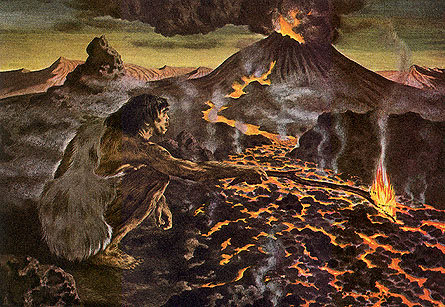
Homo Erectus somehow learned the culinary use of fire. One may suspect that Homo as well as the cheetah, the hawk, and the
lion learned to take advantage of either a field fire, or a brush fire. He stationed himself where animals fleeing the
conflagration would have to come close to him. In scavenging the animals that had been killed by the fire he must have noted
the ease and quickness by which he was able to consume the fire softened meat. Any creature that was able to solve the
technology of the hand ax was surely able to solve the problem of keeping a fire going and throwing on a quarter from an
animal that had been killed by the fire but not cooked. The charred bones remaining indicate that the first meat pieces
were cooked unskinned and in large chunks.
The great wanderers
Australopithecus and Homo Erectus were great wanderers. They wandered to the ends of the Earth throughout the tropical zone and
beyond. One group of Australopithecus went east along the shores of the Indian Ocean to Borneo. Homo Erectus wandered beyond to
Europe and into China. They both had passed through the area of the dairy industry in Persia before it had been established. At
the Pacific shore Homo Erectus went north into China.
The continental isthmus
There is one known geographic factor in the development of the mind of man: the continental isthmus. In the history of
civilization there are two such isthmuses: one in the Middle East and one between North and South America. It was near and
around each of these areas that the first cities were founded. It is interesting that the Egyptian culture, near the continental
isthmus of Asia, Europe, and Africa, was followed a couple of thousand years later by a culture creating stone pyramid type
structures and a pictorial written language near the isthmus between the Americas.
Curiosity that keeps a band of humans moving on, always around the next range of hills and mountains, is probably a large factor in capability. This type of curiosity inevitably resulted in passing through the isthmus. This interbreeding of the explorers assured that any heritable advantages would be added to the human genetic pool. It was in the isthmus of the Middle East between Africa, Europe, and Asia, that both the Mousterian (flint tools) and Aurignacian (characterized by complex art work) cultures first occurred.
The Asian branch
By enlarge, Homo Erectus evolved in Asia isolated from the West. The most ancient man found in China is dated about eighty
thousand years. He was called the Protoanthropic stage by the paleoanthropologists of the East, and recognized as Homo Erectus
by the paleoanthropologists of the West. Later stages called Paleoanthropic (600,000 - 500,000 yrs. ago) in the East follow
few of the changes characteristic in the West called Neoanthropic (500,000 - 400,000 yrs. ago). Most of these discoveries,
aside from Peking Man, who was found at the turn of the century, have been found since 1970 A. D. The Americas were apparently
settled by an early version of the Asian group who followed the hairy Mastodon over a no longer existent land bridge. They
became isolated.
Because the Asian group (Mongolians) were never introduced to the dairy products occurring in the Persian Gulf area long after they passed through, they never developed a tolerance for milk beyond the nursing period. Nineteen out of twenty Asians are made sick when they drink milk with intestinal cramps, diarrhea, and headaches.
Neanderthal
Neanderthal, a very early version of the upright human, became isolated in central Europe for some unknown reason. There is only one Neanderthal fossil found in the Far East in Java. The circumstances of the find were so unusual that some experts suspect it. Australopithecus, Homo Erectus, and Neanderthal had identical "in hand" stone tools suggesting a common ancestry. The Neanderthal was a splinter group that somehow broke off and became isolated in Northern Africa then Europe. What isolated them from the rest of Homo Erectus is a mystery. Their fossils date from 70,000 B.C. to 35,000 B.C. in this area with no other human coinhabitants. Some of their fossils are found in the Middle East along with Cro-Magnon at about the time of their extinction.
They looked more like Australopithecus than Homo Erectus. In his apparently isolated area, Neanderthal evolved greatly in size and athletic ability. Judging from the size of his bones and the muscle attachments, he was of greatest strength and agility. His broad, massive, almost simian shoulders implied brachiation (swinging through the branches), but he lived in the open plains. This suggests an alternate use of his arms. He had unmodified stones as throwing weapons. It has been suggested that he might have able to deliver a stunning blow to the head of his prey with a rock, leap on top of the prey, grasping the long hair to hold on, and smash its ribs and vertebrae with his stubby hand axe.
His simply shaped stone tools have been studied by anthropologists. They have tried to make the tools themselves. Modern imitators found that they are not strong enough to shape the stones in the same fashion as Neanderthal did. Their technique needed much more strength. Though Neanderthal wandered to the edges of the northern glaciers, they did not store food for the winters. They preyed on the large hairy herbivora which were always available, both winter and summer. Once the Neanderthal killed their prey, they hacked the carcass into large pieces and threw joints directly onto the fire without skinning them. The bones of hairy mammoth, woolly rhino, and steppe wisent (bison) are found around large hearths characterized by burned bones and bone powder. The bones of aurock (the ancestors of cattle), and moose were seldom found near the hearths. About as frequently as the cattle and moose, the bones of bear and wolves occurred. These were probably from ceremonial feasts rather than regular diet.
Neanderthal was almost entirely carnivorous. Their prognathism was ideally suited for gnawing the meat from the bones. He was defined as the man of the Mousterian stone culture. His cranium was more commodious and thicker than Homo Erectus. The skull cavity was as large as some modern men: 1200 cc to 1630 cc. It had a lower, flatter crown, but it was longer and bulged more at the sides. The face had a receding chin, the maxillae were more prominent, and heavy supraorbital ridges met across the bridge of the nose. The post-cranial bones were thicker, slightly more curved and must have carried a strong set of muscles down the back, judging from their attachments. The man stood a little more than five feet tall. The woman was a little shorter and apparently was also well muscled; a good partner to take along on a hunting trip. Brain casts indicate a massive cerebellum and motor cortex compared to Homo Erectus, as would be expected for a powerful acrobatic creature. The skull likewise was low and extended rearward farther than Homo Erectus.
We know a good deal about these people, considering. From their burials, they seem to have regarded death as a type of sleep, for we find them laid away in sleep-like positions: lying on one side with knees drawn up half way. Pollen found with the bones indicates that flowers were brought to be buried with them. We might surmise that Neanderthal considered the flowers beautiful. Stone tools and bones, most probably with meat on them, were put into the graves. These were provisions for a trip in the after world. Neanderthal knew that he would see these departed individuals again in his dreams and craved to appease their wrath so that they would not appear in frightening ways. Dirt and heavy stones were placed over them presumably to hold them down or protect them from scavengers.
Neanderthal tools and weapons consisted of saws, chisels, blades, bone and antler utensils. There is evidence of pointed sticks and posts, as well. The post holes bespeak of dwellings. A high percentage of his remains reveal evidence of murder. On the other hand, one individual was found with a withered arm. This means that his peers supported him by bringing home food for him. From all this we get an idea of wide swings of emotion and love. The cerebrum was not much developed. The cerebrum is the nerve organ that suppresses and modifies the pure emotional reactions of the primitive hypothalamus. He presumably loved intensely, and was wildly jealous. Perhaps his rages were murderous. One individual was found in a sleeping position in a cave with his head smashed by a rock. Somebody lay awake plotting until he heard the heavy breath of sleep, then stealthily crept over to him with a rock held high.
He was often found with hypertrophic arthritis at an early age in life. The four modern causes for this type of arthritis are: heredity, frustration, sun exposure, and labor. One may speculate on the goals that frustrated him. His pathology was much like a modern farmer's, but he did not sow or reap. Was his frustration in hunting, or maybe women?
He apparently had shamans who would trephine his skull for a headache and to let out demons. Neanderthal culture is full of evidence and grist for the mills of supposition. Cave bear skulls were saved in buried stone chests. Were they hunting trophies and trophies of brave deeds? Very possibly they were relics of ceremonies: the first known requiems. Even in this prehistoric offshoot of mankind, we find the early springs for the culture that inevitably followed.
The changing landscape (global climate changes)
Several great natural events occurred at the same time. The great glaciers of the Wurm period melted and retreated. The open
plains of the loess steppes and grasslands were replaced by forests. Grazing herds of the woolly herbivora were fragmented. The
sea level rose three hundred feet because of the melting polar ice. Perhaps the ice had separated Neanderthal from the rest of
Homo Erectus. We know that the isolation ended and some Neanderthal migrated to the Middle East. Shortly after this, Neanderthal
disappeared; and, without a significant gap in time, Cro-Magnon appeared in the same places.
To explain this transition concomitant with a continuously growing unbroken line of stone culture from the Mousterian to Aurignacian gives us problems. We find a different type of man suddenly living in Neanderthal's places. We have all the evidence of a replacement without sufficient evidence to support a conclusion of catastrophe among the artifacts and clues. We do know that Cro-Magnon evolved quite independently of Neanderthal. We could postulate that the Cro-Magnon brought diseases from the highly populated cities of the isthmus for which the Neanderthal, having evolved in the wide country, had no resistance.
Homo Habilus
Somewhere between Homo Erectus and Cro-Magnon we find evidence of Homo Habilus, the "skillful" worker. They were first noted by their "design" tools. These tools had a marked improvement of specialization and design. Such tools required first a mental image as to how they were to look, and required skillful work to produce them. The hand ax looked like a tear drop, and probably was so shaped because of its multi-purpose adaptability. The broad end was especially adaptable for digging roots. Its edge could fray a tendon in half. Its point could stab any creature and cause it to bleed. This tool required skill, time, and effort to produce it. It was carried along from one job to the next. Thus, it was found in places where there were no other stones like it. Its occurrence was said to be alien to the area. The mind of the creature who made it valued the tool and carried a concept of the tool in his memory bank. Whenever he made a hand ax, he used a preconceived notion of how it was to look and for what it was to be used. Also, a very important step, he had a new sense of possessing an artifact.
Cro-Magnon
Let us look more closely at some of the evidence. If you will pardon our resorting to phrenology, at least to the extent that we have learned to trust it, the casts of the skull's interiors reveals the brain of Neanderthal as the epitome of memory of sights and sounds and motor control; whereas, the skulls of Cro-Magnon revealed greater room for frontal lobes and the cerebrum. In Cro-Magnon the solution to a problem would have depended less on remembering the details of how a problem was solved last time and more on understanding similar factors of both the problems (last time, and this time).
With this new capability of generalizing, he needed less agility and less of the ability to remember. In these instances a smaller brain could be more efficient. Cro-Magnon used strategy to kill his prey. He did not need the strength and agility that Neanderthal needed. He therefore did not need as large a cerebellum. He also did not need as large occipital and temporal lobes where memories of sights and sounds were stored. Cro-Magnon had new ways of solving problems which conserved brain substance. He depended less on the comparison of details and more on the application of principles. The skull changed to accommodate a larger frontal lobe. It is notable as to how this evolutionary change came about.
Pedomorphism
The female's pelvic opening
There is something to be said about the developing pelvis. The upright biped pelvis had tended to become smaller. This
progression apparently had stopped by the time of Homo Erectus. A bigger fetal brain would have required a larger maternal
pelvis or a smaller cranial casing. The situation was on a collision course. No other animal has the problems of passing the
fetal head to the extent that humans do. In other instances in the animal world, the head is quite a bit smaller compared with
the maternal pelvic dimensions; something had to give way in man. At that time in human evolution two things happened: The skull
thinned, became more pliable, and a smaller more capable brain appeared. Cro-Magnon passed under the Arch of the Pubis between
the Pillars of Ischeum to populate the world. Pedomorphism first occurred in the Middle East and later centered around the
Mediterranean. Those moving to the south moved to a warmer climate where keeping milk was more of a problem, and therefore,
less of a dietary item. More sun to the south favored the biological adaptation of a darker skin. Less sun to the north allowed
the hairless exposure of a lighter skin. The white man to the north had a greater tolerance of milk in the ratio of eighteen out
of twenty against a lower tolerance to milk in the south in the ratio of fourteen out of twenty, and the least tolerance among
the mongolians of one out of twenty.
Foresight
Among many animals, foresight is an inherited instinct. The instinct takes at least four forms. It is no surprise that humans
also inherit foresight. Today, tests reveal that people with foresight also test better with sequential memory. This is probably
to be expected. A person with this capability can also imagine sequential possibilities extending into the future, and this would
constitute foresight. Where an instinct performs no essential function, it is not likely to persist. So it is no surprise that
human foresight developed first in the isthmus and later, most formidably, in the temperate and frigid zones where surviving
the winter was a matter of mortal concern. The most common capability which foresight gave to the world of humanity was the
activity of agriculture. Each new characteristic of an evolving animal occurs with a necessity for survival. If foresight and
insight had not been a necessity for survival under extended circumstances, it would have disappeared. Each new increment of
capability widened the field of competition and raised the threshold of survival. Foresight enabled agriculture as well as
fishing and commerce around the Mediterranean.
Picture representation
Cro-Magnon was capable of a new mental displacement. He displaced his mental concepts from his brain to the walls of caverns.
We believe that those pictures were props for magic rituals. That level of autonomy and attempted control was above and beyond
anything that had occurred before. It has been said that if we should meet Cro-Magnon on a city street, that a thrill of
admiration for his primitive ruggedness would flood through our consciousness. He was the last of pre-historic man.
Identification and the city
Not only was the concept of the tool as a weapon an important evolutionary factor, but improvements of the neurological system
of "identifying" (identifying with a group) empowered greater social coordination. The ability to identify with a larger group
was a developing advantage. This enabled another evolutionary factor: the early city of several thousand people. The city is an
attraction for those in the countryside and is the place where the most capable will eventually come to introduce any new traits
into the genetic pool. The city is also a place of the highest intellectual competition of any time. Because the city had a high
density population, there was also more disease. This became a significant evolutionary factor and is the reason why the strains
of humanity evolved in cities have a higher resistance to disease and typically a hardier internal constitution. The ultimate
success of a breeding population is to procreate a surviving succeeding generation. This, man has done to the extent that he now
inhabits all the world. We have traced the evolution of his form.
Educating the facts
For many students of the humanities, evidence as to when and how some of these things first occurred have been ignored and even
deliberately destroyed. Religious and political doctrines hold sway, and doctrines of pseudoscientific cults have come to govern
the policies of collecting and preserving evidence. In some instances, where women worked as investigators, evidences of sexual
differences were ignored. Life expectancy statistics were almost universally ignored in judging the success of a life style. An
indirect judgment of the success of a practice is also its prevalence. In many text books a single rare occurrence of a bizarre
manner of living was promoted as a proof of its feasibility. Millions of college students have had required readings of such
nonsense, and have gone forth into the unsheltered world believing such misinformation as gospel. It seems easy to conclude from
the study of evolution that might is right, but, it seems better to conclude that might is good. Strength and flexibility is
certainly good, and could be kept in mind as we look to the future.