Stories in Stone
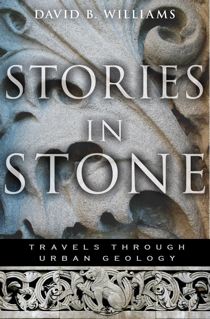
Stories in Stone
My new book project has been published by Walker & Company.
On May 3, 2009, the Boston Globe ran a story that addressed the building stone of Boston and was based on information from the book. If you are interested, you can download the story titled Boston Rocks as a 450KB PDF file.
In fall 2010, Stories in Stone was named a finalist for the 2010 Washington State Book Award in the general non-fiction category. I think that's pretty cool and I am honored to be in such august company with the other finalists and winner.
I have also started a blog about building stone: stories-in-stone.blogspot.com
Order it from your local independent or you can order it through that fine book store in Moab, Back of Beyond Books.
For additional reviews and upcoming events, please go to my Events page on this site.
"I admire the cleverness of Williams’s
device, but it would have failed were he not such a fine storyteller...His
explanation of why Carrara marble proved to be an unfortunate choice for cladding
Standard Oil’s
Chicago headquarters is unusually clear and yet lyrical. What else would you
expect from a science observer who includes a visit to Robinson Jeffers’s
(granite) Hawk Tower in his book on rocks?"
-- American
Scientist -- January/February 2010
“Author David B. Williams makes a compelling
case to look closer at a building’s very stones…Although Williams
does an admirable job of explaining where to find the stones and how they formed,
the book really shines when he talks about the human connections—how
the stone is quarried by people and added to buildings under conditions that
reflect unique historical circumstances.”
-- Earth - October 2009
“Cities may seem like the most artificial
places on Earth, yet a close look at massive buildings can reveal troves of
natural geological glory. In chapter after fascinating chapter of Stories in
Stone, Williams…deftly describes the mineralogy and history of some of
the world’s most common building materials…[T]his book reveals
that natural and cultural history may lie no farther than the building next
door.”
-- Science News - September 26, 2009
"Geologist Williams takes the study of “urban
nature” in a new and pleasurable direction by conducting a geological
survey of the stones used in city buildings...From stony metaphors to the
sculptures of Michelangelo, architectural breakthroughs, and geology’s
role in the evolution debates, Williams’ record of human dreams worked
in stone is as richly textured and full of life’s imprints as a fossil-rich
piece of travertine, the stone used on the facade of the magnificent Getty
Center
in Los Angeles."
-- Booklist - July 1, 2009
"The book is filled with terrific information,
and a whole new way to look at a city, and the world. ... The book, altogether,
is truly brilliant -- as idea, and execution."
William Wallace,
Barbara Murphy Bryant Distinguished Professor of Art History
Washington University
Stone buildings are symbols of urban denaturation,
but in this engaging popgeology excavation, Williams sees them as biological
entities. ... While telling these sagas, the author
investigates the science of rock dating and techniques of quarrying, recounts
the exploits of great geologists and the travails Michelangelo faced in transporting
marble blocks from the quarry to his workshop, and ponders the often surprising
structural and aesthetic character of different species of stone. (The coquina
stone of St. Augustine’s fortress is material for stopping cannonballs,
even though it’s as fragile as a Rice Krispies Treat.) Williams’s
lively mixture of hard science and piquant lore is sure to fire readers’ curiosity
about the built environment around us"
-- Publishers Weekly - May 3, 2009
"Stone speaks volumes with great beauty,
the author avers. Having studied geology in college, Williams spent some years
in the rapturous geologic landscape of Utah before moving to Boston. He was
starved for his geologic fix until he realized that he was surrounded by stone.
With giddy infectiousness, he launches into the cultural geology of various
rock types. … He does a yeoman’s job linking Robinson Jeffers’ love
of stone to his poetry—its strong, supple metaphorical associations,
its lasting value. … Each line of inquiry coaxes out some expressive
scientific, emotional or philosophical nugget from a piece of travertine, slate
or, in one Pop Art extravaganza, a gas station made of petrified wood.
Makes stone sing."
-- Kirkus
Reviews- May 1, 2009
“David B. Williams can see the invisible. He notices the
lost dramas fossilized in brownstones and statues, in the doorsteps and roof
slates we walk by every day. Only such an operatic theme as the enduring grandeur
of stone could encompass everything from Martian meteorites to school blackboards
to dinosaur tracks in a single book. Williams's epic story is rich in colorful
eccentrics, from Michelangelo to Robinson Jeffers, but no character comes alive
more vividly than the restless, creative Earth itself.”
—
Michael Sims, author of Apollo's
Fire and Adam's Navel
“This is the best sort of book, one that makes you see
the familiar in strange new light. Now that David Williams has warmed our stone
façades with beautifully told stories, never again will I pass a brownstone
without looking for its telltale flaws or walk the Granite City without thinking
of the natural wonders that produced its stony poetry.”
--Jennifer Ackerman, author of Sex Sleep
Eat Drink Dream: A Day in the Life
of Your Body
From the Bunker Hill Monument in Boston to the Colosseum in Rome,
David Williams distills gripping stories from building stone -- of deep geologic
time and the human quest for permanence and beauty. Thumbs up!”
--Chet Raymo, author of The Path and Skeptics and True
Believers
In this age of concrete and titanium, it may seem anachronistic
to look at building stone. But for centuries, stone was the material of choice,
and it
is still the chosen material for this country’s most elegant structures.
Reasonably fireproof, infinitely colored, and often readily available,
stone allows for larger buildings than wood and, with a few notable exceptions,
retains its structural integrity for thousands of years. Knowing that a
building's
success
or failure often rests on the choice of stone, architects and builders
continue to comb the globe, from the fjords of Scandinavia to the deserts
of South
Africa, searching for the perfect rock for their structures.
Why is stone so bewitching? Well, for one, it’s alive—a living, breathing
material that changes gracefully over time. Second, it is natural—people
may not know the stone’s origins but they intuitively sense the link
between stone and the world around them. And third, no two stones are exactly
alike,
every structure has a unique look, feel, and story.
But there’s more to it than that. Within every stone structure is a story
of geological origins that goes back to our earth’s creation. As a
self-described geo-geek, I pride myself on being able to unlock these stories.
In my new book, Stories in Stone,
I will weave together natural and cultural history to explore the untold
life
of
building
stone. The project grows out of my 20-year passion
for geology and desire to strengthen my bonds to nature. Each chapter will
focus on a particular type of rock and describe my search to learn more about
the stone,
the particular building or building style that exemplifies its use, and the
people involved in construction. Along the way I will interview geologists,
explore
quarries, and consult with preservationists and historians in order to give
readers greater insight into these structures.
By telling the stories of stone from formation to foundation, I will open a new
window for viewing the urban landscape. I will show that intriguing natural and
cultural history stories are no further than the nearest building. I hope that
Stories in Stone will encourage people to look more carefully at the natural
world around them, ask more questions, and go outside and investigate.
Here are descriptions of the book's ten chapters.

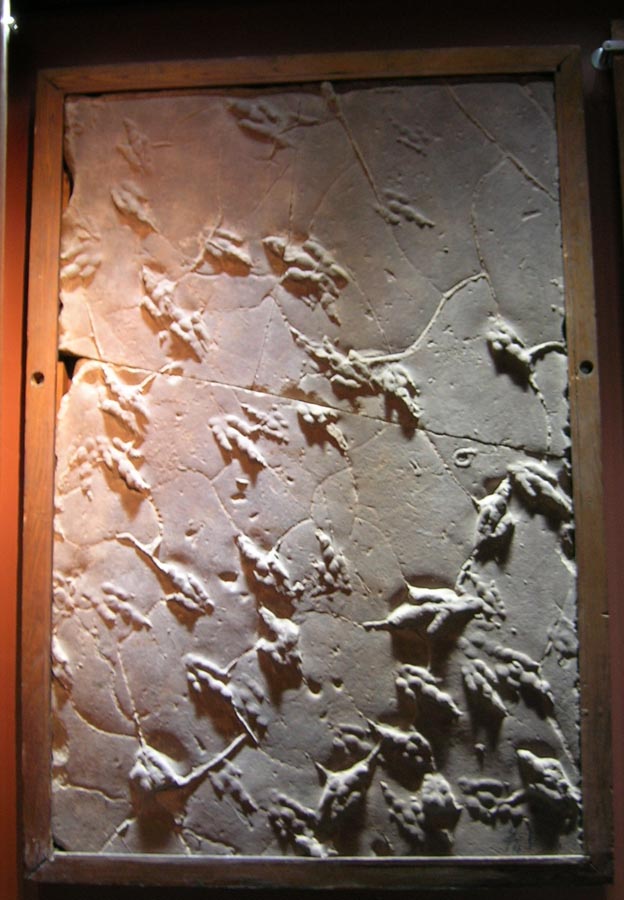 The Most Hideous Stone Ever Quarried -
During its three centuries of use, brownstone structures have housed everyone
from
destitute rowhouse dwellers
to William H. Vanderbilt,
who built a multi-million dollar mansion on New York’s Fifth Avenue.
No other stone in America has come to symbolize and embody such socioeconomic
extremes. From a geological perspective, brownstone formed 200 million years
ago when streams deposited sediments into a valley created by the initial breakup
of the supercontinent of Pangaea. The valley teemed with dinosaurs, who left
their tracks in the soft sands and muds. Over 20,000 of the tracks, including
the first discovered evidence of dinosaurs in North America, are now preserved
in stone at the Amherst Museum of Natural History.
The Most Hideous Stone Ever Quarried -
During its three centuries of use, brownstone structures have housed everyone
from
destitute rowhouse dwellers
to William H. Vanderbilt,
who built a multi-million dollar mansion on New York’s Fifth Avenue.
No other stone in America has come to symbolize and embody such socioeconomic
extremes. From a geological perspective, brownstone formed 200 million years
ago when streams deposited sediments into a valley created by the initial breakup
of the supercontinent of Pangaea. The valley teemed with dinosaurs, who left
their tracks in the soft sands and muds. Over 20,000 of the tracks, including
the first discovered evidence of dinosaurs in North America, are now preserved
in stone at the Amherst Museum of Natural History.
Vanderbilt’s mansion is long gone but numerous brownstone fronted rowhouses still dominate the streets of Brooklyn. They have again become a fashionable place to live and many are being restored to their former elegance. In response to the growing demand for the stone, a new quarry has opened adjacent to the historic quarries in Portland, Connecticut. Although Edith Wharton called brownstone "the most hideous stone ever quarried," it is still popular after over 350 years of use.
The Granite City - Solom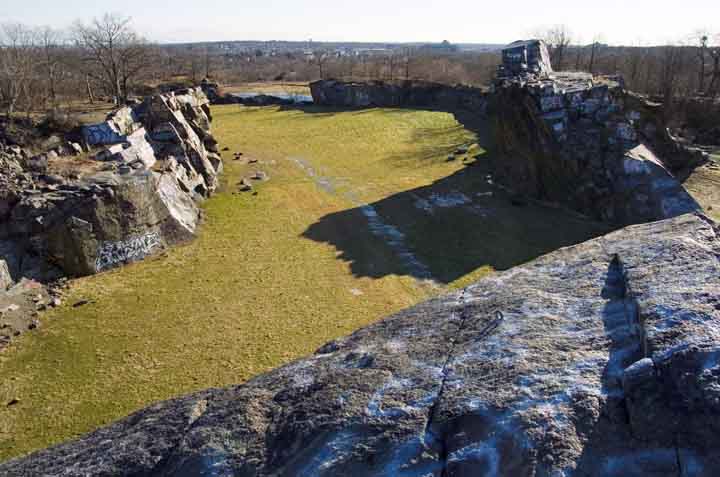 on
Willard walked 300 miles across New England before he found the perfect stone
for Boston’s
Bunker Hill Monument in Quincy, Massachusetts. The granite was so critical
to Willard’s
plans that it led to the construction of America's first, commercial railroad.
Willard could
only use that 450-million-year-old stone because Massachusetts Lt. Governor
Edward H. Robbins happened across an itinerant stone worker, Mr. Tarbox (his
first name has been lost to history), who had developed a new method of cutting
stone, which dropped the price of cut rock by 60 percent.
on
Willard walked 300 miles across New England before he found the perfect stone
for Boston’s
Bunker Hill Monument in Quincy, Massachusetts. The granite was so critical
to Willard’s
plans that it led to the construction of America's first, commercial railroad.
Willard could
only use that 450-million-year-old stone because Massachusetts Lt. Governor
Edward H. Robbins happened across an itinerant stone worker, Mr. Tarbox (his
first name has been lost to history), who had developed a new method of cutting
stone, which dropped the price of cut rock by 60 percent.
The construction of the Bunker Hill Monument made granite the building stone along the east coast during the early to mid nineteenth century. Quarries in Quincy provided stone for structures across the United States and stayed open until 1963. But now the 210-deep quarry, once used for dumping cars, trash, and the occassional body, has been filled, with dirt from the Big Dig. All that remains of one of the great industrial sites in New England is a bucolic field of grass, grafitti, and granite.
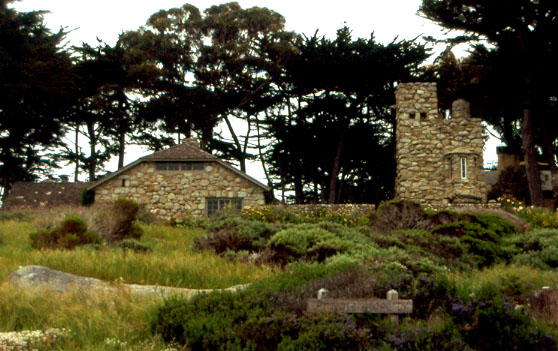 Poetry in Rocks - Iconoclastic thinker Stewart
Brand called poet Robinson Jeffer’s home “the most intelligent
building per square inch ever built in America.” Made from granite boulders
Jeffers collected from the beach below his home in Carmel, California, the
house and 40-foot high tower don’t
appear to be built so much as they appear to emerge geologically from the hillside,
as if Jeffers had used the nearby cliffs, sea stacks, and outcroppings for
blueprints.
Poetry in Rocks - Iconoclastic thinker Stewart
Brand called poet Robinson Jeffer’s home “the most intelligent
building per square inch ever built in America.” Made from granite boulders
Jeffers collected from the beach below his home in Carmel, California, the
house and 40-foot high tower don’t
appear to be built so much as they appear to emerge geologically from the hillside,
as if Jeffers had used the nearby cliffs, sea stacks, and outcroppings for
blueprints.
Up close, the buildings, known as Tor House and Hawk Tower, sustain the first impressions of geology manifest as home. No two blocks are alike and rarely do stones of the same size rest next to each other. Edges are not perfectly straight but look weathered and eroded. Barnacles still cover some of the stones Jeffers liberated from the sea. Finger trails run through the mortar, trace fossils of a man and his passion. In an homage to Tor House, Jeffers wrote “My fingers had the art to make stone love stone.”

Deep Time in Minnesota - No matter where you look at rocks, you are missing most of the story. Either erosion has removed layers, no layers were deposited in the first place, or the layers lay underground and cannot be seen. If you live in a city, the geologic story may barely equal a paragraph of time. Going to a wilder locale may add only a few chapters to the story. Even the Grand Canyon’s mile of rock fails to convey a complete story. Curiously, one of the most beautiful building stones has one of the longest story lines of any rock on the planet. The geologic tale of the Morton Gneiss (pronounced “nice”), quarried in Morton, Minnesota, stretches from its origin 3.5 billion years ago to 12,900 years ago. In that time the swirly pink, gray, and black, heavily metamorphosed Morton rocks were buried, baked, squeezed, warped, uplifted, injected with magma, and stripped bare by massive rivers.
 The
Clam That Changed the World -
In the first 107 years of St. Augustine, Florida’s existence
(1565-1672), rain, rot, Englishmen, and fire destroyed nine forts. In the subsequent
300-plus years, only one fort has stood in town. Known as the Castillo de San
Marcos, it was built by Spanish colonists out of the only locally available
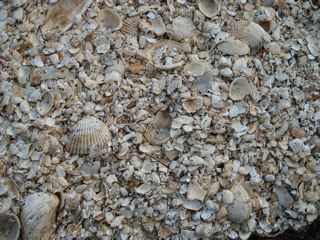
stone, coquina, a limestone made from shells, shell fragments, and sand. Coquina
was the first building stone used by Europeans in what would become the United
States.
The
Clam That Changed the World -
In the first 107 years of St. Augustine, Florida’s existence
(1565-1672), rain, rot, Englishmen, and fire destroyed nine forts. In the subsequent
300-plus years, only one fort has stood in town. Known as the Castillo de San
Marcos, it was built by Spanish colonists out of the only locally available
stone, coquina, a limestone made from shells, shell fragments, and sand. Coquina
was the first building stone used by Europeans in what would become the United
States.
Many people liken coquina’s consistency to a Rice Krispy treat but I
lean more toward a granola bar with shells and shell fragments replacing the
oats. Oddly, it was an ideal stone for a fortress because cannon balls either
bounced off of or were absorbed by the stone’s spongy texture. Because
of this property, no army ever took the Castillo by force, which allowed Spain
to stay in Florida and protect its lucrative New World colonies.
America’s Building Stone - Walk through most any major city in the United
States and you will find a white to buff limestone gracing some of the more
elegant buildings. Look closely and you will discover that the stone is a graveyard
of invertebrates, with brachiopods, one to two-inch wide, clam-like shells;
crinoids, consisting of a cup-like calyx and thin, ridged discs, some stacked
five or ten high; and bryozoans, which resemble broken bits of Rice Chex cereal.
Known as the Salem Limestone and quarried in Indiana, the 330-million year
old sea deposited rock is the most commonly used building stone in the country.
Pop Rocks, Petroleum, and Petrified Wood – In the 1930s, Bill Brown
built a gas station out of petrified wood. Located in the tiny town of Lamar,
in the southeastern corner of Colorado, the station quickly attracted atten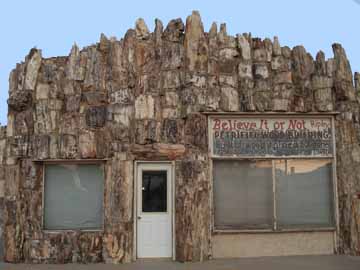 tion.
Robert Ripley featured it in his Believe It or Not! column in 1935, describing
it as “Built Entirely of Wood Turned to Stone.” Brown’s petrified
wood also intrigued Phillips Petroleum founder, Frank Phillips, who tried to
buy the building. When Brown refused to sell, Phillips simply bought 48,025
pounds of petrified wood from near where Brown obtained his material and shipped
it back to his estate in Oklahoma. He never built it but when Phillips turned
66, Lamar residents gave him a model of their station built entirely of bits
of petrified wood.
tion.
Robert Ripley featured it in his Believe It or Not! column in 1935, describing
it as “Built Entirely of Wood Turned to Stone.” Brown’s petrified
wood also intrigued Phillips Petroleum founder, Frank Phillips, who tried to
buy the building. When Brown refused to sell, Phillips simply bought 48,025
pounds of petrified wood from near where Brown obtained his material and shipped
it back to his estate in Oklahoma. He never built it but when Phillips turned
66, Lamar residents gave him a model of their station built entirely of bits
of petrified wood.
 The Trouble with Michelangelo’s Marble - Over five
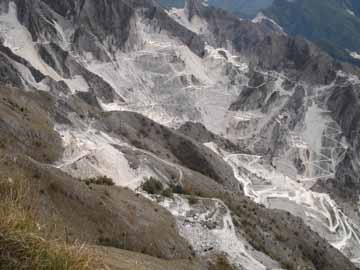
hundred years ago, Michelangelo carved his statue of David out of Carrara marble
and the biblical
hero still looks as good as new. But when the petroleum giant Standard Oil
decided to build its landmark headquarters in Chicago in the same marble, the
stone panels didn’t last nineteen years. Unfortunately, none of the hundreds
of geologists on the company payroll had accounted for the Windy City’s
harsh weather, which caused the panels to warp and bend. Fewer than twenty
years after the building’s construction, Standard had to shell out $70
million to replace all 44,000 marble panels. Once again, the prestige and allure
of marble had seduced an architect and builders.
The Trouble with Michelangelo’s Marble - Over five
hundred years ago, Michelangelo carved his statue of David out of Carrara marble
and the biblical
hero still looks as good as new. But when the petroleum giant Standard Oil
decided to build its landmark headquarters in Chicago in the same marble, the
stone panels didn’t last nineteen years. Unfortunately, none of the hundreds
of geologists on the company payroll had accounted for the Windy City’s
harsh weather, which caused the panels to warp and bend. Fewer than twenty
years after the building’s construction, Standard had to shell out $70
million to replace all 44,000 marble panels. Once again, the prestige and allure
of marble had seduced an architect and builders.
Reading, Writing, and Roofing - We look to marble for its beauty. We turn
to granite for its durability. We build with brownstone because the Vanderbilts
did. Sometimes, though, we just need a rock that gets the job done. Nothing
fancy or famous or beautiful. And for that, no rock surpasses slate. From blackboards
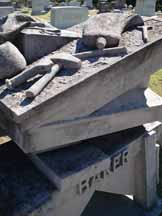
to roofing tiles to gravestones, slate is the most utilitarian stone in the
trade.
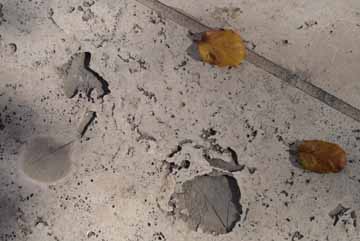
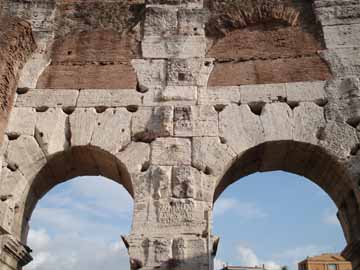 Autumn
20,000 Years Ago -
Few building stones in the world have the pedigree of travertine. First used
by the Romans over 2,000 years ago, it is still one
of the most commonly used building stones in the world, appearing in structures
from the Middle East to the Midwest. Two of the most famous travertine structures
are the Colosseum in Rome and Getty Center in Los Angeles. Geologically, the
travertine is very young. The quarries in Tivoli, 20 miles from Rome, are in
rock younger than 200,000 years old, and some is as young as 20,000 years old.
In addition, the study of travertine has had a profound affect on scientists,
including the ones responsible
for studying a 4.5-billion-year-old meteorite, the one that
in
1996 NASA claimed showed evidence for life on Mars.
Autumn
20,000 Years Ago -
Few building stones in the world have the pedigree of travertine. First used
by the Romans over 2,000 years ago, it is still one
of the most commonly used building stones in the world, appearing in structures
from the Middle East to the Midwest. Two of the most famous travertine structures
are the Colosseum in Rome and Getty Center in Los Angeles. Geologically, the
travertine is very young. The quarries in Tivoli, 20 miles from Rome, are in
rock younger than 200,000 years old, and some is as young as 20,000 years old.
In addition, the study of travertine has had a profound affect on scientists,
including the ones responsible
for studying a 4.5-billion-year-old meteorite, the one that
in
1996 NASA claimed showed evidence for life on Mars.
If you are interested in reading more, here are a couple of articles I have previously written on building stone.
Building Stone in Boston - I wrote this for Harvard Magazine in 1997. I modified this version slightly and added photographs from my friend Adam Shyevitch. It contains many of the facets of building stone geology—fossils, architecture, history, and plate tectonics—that most interest me. To open a 1.1 mb PDF file, please click on A Geologist's Harvard.
Building Stone Tour of Seattle - This is a modified version of the chapter from The Street-Smart Naturalist. It is not exactly a step-by-step guided tour but if you were to walk from building to building as described in the tour you would more or less follow a logical path. To open a 400 kb PDF file, please click on Downtown Rock Hound.